A deep fear of government is shared by Cambodians, many of whom experienced the violence of the Cambodian genocide, a four-year period in the 1970s when the communist Khmer Rouge regime killed nearly 2 million people.
"Just the word 'government' would trigger a lot of traumas of killing, violence, not just to ourselves but to our children or to our loved ones," said Som, a community activist who lives in Long Beach, California, the U.S. city with the largest concentration of Cambodians.
Recalling the first time she became involved in local civic activities, Som said, "My mother received a call from a community leader to say how horrible of a mother she was to allow such a young college kid (to) participate in civic engagement events."
Som's experience as a Cambodian-American is not unusual.
During every election season, Cambodian-Americans have remained noticeably silent. Som said her community has traditionally avoided the polls during elections and have taught their children not to get involved.
Som said during the U.S. Census, which attempts to count every resident in the country, many Cambodian-Americans either do not participate or misreport the numbers in their households because they fear being on a government list.
Civics engagement
However, the 2018 midterm election season is proving to be different. Many Cambodian-Americans in Long Beach are on a mission to create political change for their community by pushing for a seat at the table in city government so their voices can be heard.
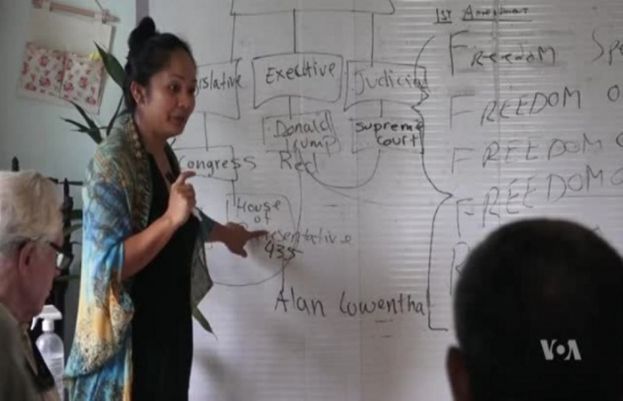
The movement was born during a civics class taught by Som at the MAYE Center, a center she founded to help fellow Cambodian genocide victims heal from the trauma they suffered and located in the heart of Long Beach's Cambodia Town. (The four elements of self-healing at the MAYE Center include meditation, agriculture, yoga and education.)
One of her students, Vy Sron, remembered the discussion that started a tidal wave within the community.
"When the teacher said that (the) Cambodian community does not have a political voice like other communities, I asked the question of 'why does the Cambodian community not have such political voice?' "
Som said she believes more political representation would help bring a cultural awareness and sensitivity to the needs of her community.
"We have members, elders who would go up to council and speak Cambodian, and we didn't have anyone translating," Som said. "We're people of the earth. We want plants and gardens. This is how we heal ourselves, but yet we are put in a community where it's a cement jungle."
About 20,000 Cambodian-Americans live in Long Beach, or about 4 percent of the city's population of 486,000, according to the Long Beach Convention and Visitor's Bureau. More than half of the Cambodian-Americans in Long Beach live in and around an area known as Cambodia Town, a 1.2-mile business strip of Khmer-owned restaurants, shops and temples, according to the bureau.
However, the area in and around Cambodia Town is currently part of four of the city's nine council districts. And each of the four districts is represented by a different council member, meaning any political clout the Cambodian community might have is diffused.
The students in the MAYE Center civics class decided to take action, organizing their community and collecting signatures for a petition to ask the city of Long Beach to redraw district lines so the largely Cambodian community could be consolidated into one district, with one representative.
But they are learning that seeking representation is a complicated matter that takes work and patience.
Cities typically look at redrawing district boundaries every 10 years, after the U.S. Census, so the population can be equally divided. The Long Beach city charter also allows the city to redistrict every five years or at any time the City Council feels there is a need.
In the last redistricting, in 2011, the Long Beach City Council adopted criteria for redrawing district lines, including "splits in neighborhoods, ethnic communities and other groups having a clear identity should be avoided."
Som said council members did not follow that criteria when they split the area in and around Cambodia Town among four districts. The MAYE Center group wants the city to redraw the boundary lines, consolidating the Cambodia Town area into one district, before the next U.S. Census in 2020. The new district would allow Cambodian-Americans to vote for someone who would more solidly represent their interests in the 2020 election cycle, the group said.
"All the students took part in educating one Cambodian resident at a time, (and) have collected 3,000 signatures in two months," Som said.
Civil rights attorney Marc Coleman said other ethnic minority groups have been successful with similar endeavors in the past.
"The Latino community did the same thing, and they created what ... they call the Latino District," said Coleman, who is also treasurer of the MAYE Center.
Midterm elections
The group's efforts are twofold in this election. The Cambodian community is also supporting a proposal on the November 6 ballot to amend the Long Beach city charter to create an independent, citizen-led redistricting panel, taking that duty away from City Council members. The hope would be to have a member of the Cambodian community on the panel, the group added.
Long Beach city officials, however, said redistricting of the city will not be considered until after the 2020 Census to get the most accurate population count. Who is involved in the redistricting process will depend on the results of the November vote on the independent commission.
Guatamalan native and Long Beach resident Juan Ovalle, who also fled an oppressive government, said he supports the Cambodian community's efforts for representation, but he opposes the ballot measure, calling it a façade by politicians that would only allow residents to think they have more control over redistricting. He warned the Cambodian community not to be fooled.
"It (the redistricting committee) is still beholden to political influences. Those that will select the members of the redistricting committee are basically politicians," Ovalle said.
Coleman, of the MAYE Center, in responding to Ovalle said, "This is as good as we could get it. Nothing is perfect. Nothing is foolproof, but we feel confident this is a good system."
Knowledge is power
Charles Song, who survived the Cambodian genocide, said he had tried in the past to organize the Long Beach Cambodian community, but was never very successful.
"The roadblock is always here, because when you're talking about the Cambodian community, the first thing is fear," he added.
Song said experts from outside the community, whom he credits with empowering residents by teaching them how city government works, are behind the intense interest among Cambodian-Americans in this year's election.
For Som, whose civics class ignited the students' interest in local politics, this has also been an exercise in trying to persuade her mother to trust the U.S. government.
"I have to remind her that this is a different political landscape, that many have died in this country to give us this kind of voice and that we could do it," she said.
Comments
Post a Comment