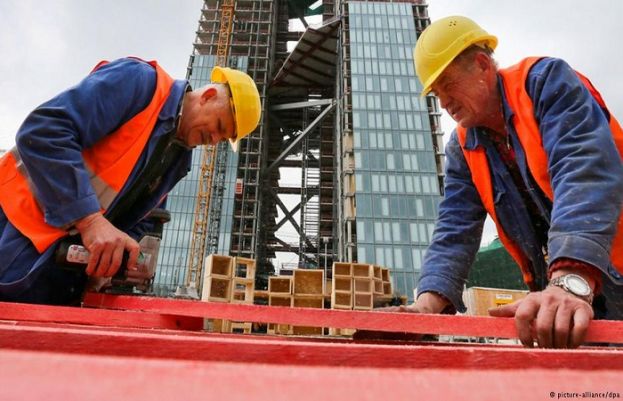
Migrants from EU boosting the German economy: study

Migrants from EU boosting the German economy: study
Migrants from across the European Union have made a considerable contribution to economic growth in Europe's powerhouse, a fresh study by a leading German think tank reveals. But they don't always get the jobs they want.

 Workers from fellow European Union countries were crucial in increasing economic output in Germany between 2011 and 2016, a study by the Berlin-based German Institute for Economic Research (DIW) showed Wednesday.

In the period under review, migrants from across the EU added an average 0.2 percent of GDP growth annually. The study said their contribution to Germany's overall economic output was particularly big in 2015 as a result of an above-average influx of skilled labor from the bloc.

The overwhelming majority of the new arrivals was able to find employment and thus fueled private consumption in Germany.

According to DIW researchers, a total of 5.1 million migrants from other EU nations came to Germany between 2011 and 2015, with the high number attributable to the introduction of the free movement of goods and labor for most countries in the bloc in 2011.

As of 2014, the rules have also applied to migrants from Romania, Bulgaria, and as of 2015 to Croatia.

In pursuit of good jobs

The study noted the vast majority of migrants from the nations in question came to find employment in Germany as the economic situation in their home countries had worsened in the wake of the global financial crisis and the ensuing debt crisis in much of Europe.

Most of the EU migrants entering the German job market were young and highly skilled, the survey pointed out, helping Germany to cope better with the downsides of an aging population reflected also in a shortage of skilled labor.

"Germany will have to double its efforts to remain attractive for skilled labor from the EU now that the economic situation in the eurozone and the larger EU is looking up again," said Marius Clemens, the author of the DIW study.

He emphasized it would be necessary to find a more pragmatic procedure of employing migrants according to their skills and qualifications.


Comments

Popular posts from this blog

IHC to hear Nawaz Sharif’s bail plea on medical grounds today

The Islamabad High Court (IHC) will take up the plea filed by the former prime minister Nawaz Sharif seeking bail in the Al-Azizia case on medical grounds on Wednesday (today). The division bench comprising Justice Aamir Farooq and Justice Mohsin Akhtar Kayani will preside the hearing. In the last hearing, the National Accountability Bureau (NAB)had submitted its detailed reply in the court. The NAB has requested the Islamabad High Court (IHC) to throw out a petition filed by former prime minister Nawaz Sharif seeking his release from prison on medical grounds. In a detailed reply submitted to the IHC in response to Sharif’s plea, the anti-graft watchdog stated that the petition at hand is the third one seeking relief on the grounds similar to previous ones and therefore, is not maintainable and liable to be dismissed with exemplary costs. NAB stated the grounds on the basis of which Sharif sought his release are “non-conclusive observations contained in a medical report of the ...

PM Khan to chair party meeting today

Prime Minister Imran Khan has summoned a meeting of Pakistan Tehreek-e-Insaf’s (PTI) leaders and spokespersons on Saturday to discuss the current political situation and budget-2019. As per details, PM Imran Khan would preside over the meeting at his Bani Gala residence and briefed the participants about the party’s narrative in the wake of current situation, said sources. PTI’s strategy for the next session of the National Assembly, economic targets and other issues would also be discussed in the meeting, the sources added. Earlier on June 11, Prime Minister Imran Khan had announced to establish a high-powered commission under his supervision to find out facts behind soaring of loans to Rs24,000 billion in last 10 years. The commission would be comprised of officials from Inter-Services Intelligence (ISI), National Accountability Bureau (NAB), Federal Investigation Agency (FIA), Securities and Exchange Commission of Pakistan (SECP) and Federal Board of Revenue (FBR), he had said...

PM Khan had ended tolerance for corruption: Fawad Chudry

Information Minister Fawad Chaudhry on Sunday asserted that all state institutions stand by Prime Minister Imran Khan and are working together to lead the country toward development. While talking to journalists, Information Minister Fawad Chaudhry said that before Khan came to power, every politician thought that “corruption was their right”. However, PM Khan had ended tolerance for corruption after he assumed office, Chaudhry claimed. When people do not have money to buy medicines then how can a prime minister live lavishly?” said Fawad Chaudhry. “They [the previous government] had ordered cars worth Rs980 million for one SAARC conference,” Chaudhry said, adding that the maintenance expenditure of the cars amounted to Rs350m. He said that previous governments had left the country up to its eyeballs in debt by spending huge amounts of money on extravagance. The new premier was trying to repay this debt. He further said that the budget allocated to state institutions like Pakist...